A mandate is more useful than a name
Start by defining the project’s funding need. A seed investor, infrastructure equity fund, commercial bank, development finance institution and strategic buyer do not evaluate the same opportunity in the same way.
For each candidate, verify geography, technology, stage, ticket size, instrument and the source date. Prefer the investor’s own mandate and programme documentation. An old transaction or directory entry does not prove a current appetite.

Read the diagram as text
Question: The decision to be made → Sources: Official · dated · scoped → Interpretation: Observed vs scenario → Action: Evidence and next decision
Build a fit matrix
| Development equity | Does the investor accept pre-construction risk and sponsor-level exposure? |
| Project debt | Are contracted revenues, permissions, security and debt-service capacity established? |
| Infrastructure equity | Does the asset’s stage, scale and return profile match the investment mandate? |
| Strategic capital | Is there a specific commercial relationship, supply chain or acquisition thesis? |
| Concessional or blended finance | Are eligibility, additionality, programme timing and reporting obligations satisfied? |
Record the reason for fit
A shortlist should contain a short evidence-backed reason for each inclusion. Include the official mandate URL, the date checked, the proposed instrument and the unresolved eligibility question. This makes handovers and future updates easier.
Do not infer that an institution will fund a project because it has funded the same technology elsewhere. Country exposure, stage, borrower structure and minimum ticket can change the conclusion.
A disciplined outreach workflow
- Define
Write the capital requirement and transaction structure.
- Verify
Read current official mandate and programme terms.
- Prioritize
Rank genuine fit, decision timing and evidence requirements.
- Prepare
Tailor a concise briefing to the investor’s mandate.
- Track
Record questions, follow-up dates and the current model version.
What happened to the original database?
The archived April 2012 page described a paid online product with more than 400 financier profiles. That dated claim is part of the historical record. This site does not present an unverified list of 400 current investors or imply that the old subscription is available.
The replacement is a transparent shortlist framework. Use the project-brief builder to produce your own first-discussion document, then maintain candidate details in your organization’s research process.
Your project, clearly described
Prepare a text document locally. Nothing is submitted. Do not enter confidential details.
Preview the document
Sources & further reading
Source dates and reporting periods apply. External publishers do not endorse this website.
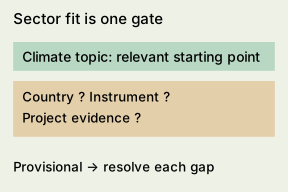
Keep a shortlist candidate provisional when one gate is unknown
A climate-finance headline is a starting point for research. It is not a financing commitment to your project. IFC's public financing page lists several eligibility criteria, including location, private-sector status, technical soundness, profitability prospects, local benefits and environmental and social requirements. Meeting one broad topic does not settle the other criteria.
- Freeze the request. Record the project's country, stage, borrower or investee, instrument, currency and amount. Keep assumptions visible instead of changing them to fit a promising name.
- Use the institution's own pages. Record each fit dimension with its exact official URL, date read and the passage that answers it. An announcement about another project supplies context, not automatic eligibility for this one.
- Separate match, mismatch and unknown. If a criterion is missing from the available evidence, write the next question. Do not score unknown as a match or infer a minimum ticket from a past transaction.
- Decide the next research action. Exclude a clear mismatch from this shortlist with a reason. Keep an unresolved candidate provisional. Only then prepare a factual project brief and verify the appropriate contact route independently.
Completed fictional shortlist row
Project S seeks development-stage equity for a privately owned solar business in Country X. A climate page suggests sector relevance; the analyst has not established Country X's eligibility, the instrument's fit or the project's environmental and social evidence. Status: provisional, three explicit gaps. Next action: verify the country and transaction requirements on official pages, and identify the missing project documents. No outreach or application has been made in this example.
Reusable row: institution/source/date ___; country ___; stage ___; instrument ___; amount/currency ___; project evidence ___; match/mismatch/unknown per field ___; next check and owner ___. A fully filled row improves preparation; it still does not establish approval or investor appetite. Keep private commercial details out of a public worksheet.