
How the checklist works
Mark an item only when a dated document or documented decision supports it. The tool counts evidence categories and identifies unchecked items. It does not assess borrower credit, price debt or certify a project as bankable.
Your selections stay in this page’s memory. They are not sent to a server and disappear when the page is reloaded. Print the completed view for a team discussion.

Read the diagram as text
Project: Rights · resource · stage → Commercial: Offtake · delivery · costs → Evidence: Model · permits · diligence → Capital: Mandate · terms · closing
Turn a gap into an action
Give the unresolved item an owner, a deadline and a clear acceptance criterion. For example, “obtain a tariff” is vague; “confirm the current official tariff scheme, application eligibility and contract status” is a reviewable task.
Compare the evidence requirements with the project’s current stage. An early development opportunity may legitimately have gaps. Its funding request should explain how the next round resolves them, rather than hiding them.
Funding-readiness checklist
Mark only items supported by evidence. This records document coverage, not creditworthiness or funding approval.
Sources & further reading
Source dates and reporting periods apply. External publishers do not endorse this website.
Reopen a readiness check when its evidence no longer fits
A tick should refer to a particular document and decision, rather than a folder that happens to contain a file. Review its version, scope and outstanding questions whenever the project changes. The World Bank describes progressively more detailed appraisal through a PPP project cycle; the record below adapts that review principle to a fictional evidence checklist. It is not a lender’s approval process.
- Name the exact question behind the checkbox. For example: does the technical review cover the proposed project configuration?
- Open the supporting file and record its title, date, version, project boundary and author or issuing organisation. Distinguish a draft, a signed document and a summary of somebody else’s work.
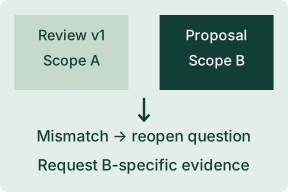
- Compare that scope with the current proposal. If a component, site or assumption changed, record the mismatch. Leave the category unresolved until a competent reviewer addresses it.
- Assign a specific evidence request and an acceptance check. At the next review, inspect the replacement document; a promise to send it is not the document itself.
Fictional case: the file index contains “Technical review, version 1, 1 October”. The proposal now describes configuration B, while the review covers configuration A. The file’s existence does not close the current technical question. The checklist entry becomes “scope mismatch; unresolved”. The action owner requests a review explicitly naming configuration B and a list of remaining assumptions by 12 November. That illustrative date is a task deadline, not a promised financing date.
Acceptance: the reviewer identifies configuration B, records the review date and limitations, and answers the outstanding scope question. If the returned file still describes A, keep the gap open and explain why. If it describes B but identifies unresolved issues, record those issues rather than marking the entire project finance-ready.
Evidence record: question ___; document title/version/date ___; current project scope ___; scope actually reviewed ___; mismatch or unknown ___; action owner ___; due date ___; replacement evidence ___; decision and reviewer ___; next review trigger ___. Do not place confidential commercial documents in a public form. The interactive checklist above remains a local planning aid; these steps do not estimate creditworthiness, probability of funding or investment returns.
World Bank PPP Reference Guide: iterative appraisal across the project cycle